

Google has officially released its first-ever AI Optimization Guide, providing clear guidance on how websites can improve visibility in AI-powered search experiences such as AI Overviews, AI Mode and future AI-driven search features. The biggest takeaway? SEO is not dead. In fact, SEO is more important than ever. For the past two years, marketers have been flooded with terms like GEO (Generative Engine Optimization), AEO (Answer Engine Optimization), LLMO, AI SEO and countless “AI ranking hacks.” Google’s new documentation finally cuts through the noise and explains what actually matters. Google’s Message Is Clear: AI Optimization Is Still SEO According to Google, AI-powered search experiences rely on the same core search systems, crawling processes, indexing mechanisms and ranking signals used in traditional Google Search. AI Overviews and AI Mode don’t use a separate index. If your website cannot be crawled and indexed properly, it won’t appear in AI-generated answers either. This means: Technical SEO still matters Content quality still matters User experience still matters Authority and trust still matter The fundamentals haven’t changed – the way users consume search results has. What Google Recommends for AI Visibility 1. Create Original, Experience-Based Content Google emphasizes the importance of what it calls non-commodity content. Commodity content is information that can be found on hundreds of websites and easily generated by AI. Non-commodity content includes: First-hand experiences Original research Case studies Unique insights Proprietary data Expert opinions If your content provides information nobody else can offer, it becomes more valuable for both traditional search and AI-generated responses. 2. Focus on Helping Users, Not AI Google continues to promote a people-first approach to content creation. Instead of asking: “How can I optimize this page for AI?” Ask: “How can I make this page genuinely useful for my audience?” The websites that solve real problems and answer real questions are the ones most likely to earn visibility in AI-generated search results. 3. Maintain Strong Technical SEO AI systems can only use content they can access. Key technical requirements include: Crawlable pages Proper indexing Fast loading speeds Mobile-friendly design Clean site architecture Structured content hierarchy These remain foundational ranking factors. 4. Improve Content Structure While Google says there is no special “AI format,” well-structured content helps search systems understand information more efficiently. Best practices include: Clear headings (H1, H2, H3) FAQ sections Tables where appropriate Concise answers Logical content flow Structured content benefits both users and AI systems. 👉 Also Read: Google Preferred Sources: A Major Opportunity for Publishers and Digital Marketers AI SEO Myths Google Just Debunked One of the most valuable parts of Google’s guide is the list of tactics that do not provide AI search advantages. Myth #1: You Need an llms.txt File Many marketers claimed AI platforms require an llms.txt file to understand your content. Google explicitly states that this file is not required for AI visibility and is not treated as a ranking signal. Myth #2: AI Search Requires Special Schema There is no AI-specific schema markup that improves AI Overview rankings. Continue using structured data where appropriate, but don’t expect special AI benefits from new schema types. Myth #3: Content Must Be Chunked for AI Some SEO consultants recommend breaking every article into tiny content blocks. Google says its systems already understand content across entire pages and don’t require artificial chunking. Myth #4: Rewrite Content for AI Keywords AI systems understand context, intent and natural language. Stuffing content with “AI-friendly” phrases or awkward keyword variations won’t improve visibility. Myth #5: GEO Hacks Can Guarantee Citations Google recently updated its spam policies to address attempts to manipulate AI-generated responses. Websites using deceptive tactics to influence AI recommendations may face penalties. What This Means for Businesses The businesses that will win in AI search are not necessarily those producing the most content. They are the ones producing the most useful content. Successful brands should focus on: Publishing expert-driven content Sharing real-world experience Creating detailed case studies Building topical authority Demonstrating expertise and trust AI search rewards content that adds value rather than repeating information already available elsewhere. The Future: Preparing for AI Agents Google’s guide also hints at a future where AI agents interact directly with websites. These systems may navigate websites, complete tasks, analyze page structures and assist users beyond simple information retrieval. As AI capabilities evolve, websites that are accessible, structured and user-friendly will be best positioned to benefit. Final Thoughts Google’s AI Optimization Guide delivers a message that many SEO professionals have been waiting to hear: There is no secret AI SEO formula. The path to visibility in AI Overviews and AI Mode is built on the same foundation that has driven successful SEO for years: Create exceptional content Solve real user problems Demonstrate expertise Maintain strong technical SEO Build trust and authority Businesses chasing shortcuts and AI ranking hacks may find themselves wasting time and budget. Businesses focused on delivering genuine value will continue to earn visibility – whether users see it in traditional search results or AI-generated answers. Need Help Preparing Your Website for AI Search? At GenixCrew, we help businesses build future-ready SEO strategies that improve visibility across Google Search, AI Overviews and emerging AI-driven search experiences. Ready to future-proof your SEO? Contact GenixCrew today and let’s build an AI-ready search strategy for your business.
Google Preferred Sources: A Major Opportunity for Publishers and Digital Marketers
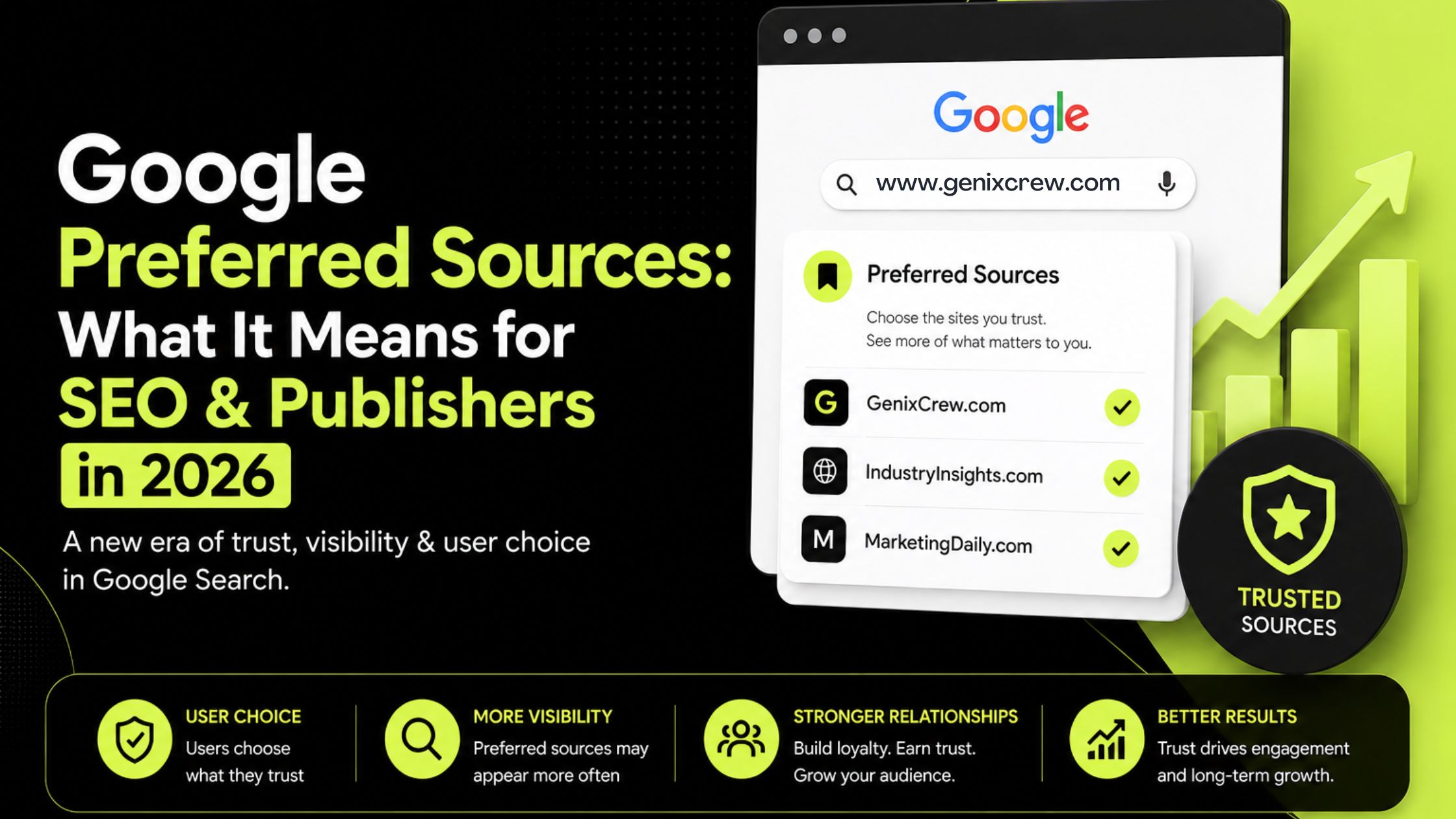
Google has officially documented its Preferred Sources feature, giving users more control over the websites they want to see in Google Search. This update marks an important shift in how content is discovered, consumed and trusted online. For publishers, bloggers, news websites and digital marketers, this feature could become a powerful new traffic and brand visibility channel. What is Google Preferred Sources? Google Preferred Sources allows users to select websites they trust and want to see more often in search results. When those selected websites publish relevant content, Google may highlight them more prominently in areas such as: Top Stories AI Overviews AI Mode Personalized search experiences Instead of relying entirely on Google’s ranking algorithms, users can now influence which publishers appear more frequently in their search journey. Google recently expanded this functionality beyond Top Stories and into AI-powered search experiences. Why This Update Matters For years, publishers focused on ranking signals, backlinks, technical SEO and content quality. While those factors remain critical, Preferred Sources introduces a new element: User preference. If users actively choose your website as a trusted source, Google may give your content additional visibility whenever it is relevant to their searches. Google has indicated that users are significantly more likely to engage with content from sources they have selected as preferred. What It Means for SEO This update reinforces several long-term SEO trends: 1. Brand Authority Matters More Than Ever SEO is no longer just about ranking for keywords. Businesses must build: Brand recognition Audience loyalty Thought leadership Trust signals The stronger your brand becomes, the more likely users are to add your website as a Preferred Source. 2. E-E-A-T Becomes Even More Important Google continues to reward: Experience Expertise Authoritativeness Trustworthiness Publishers producing original, expert-driven content will have a better chance of becoming trusted sources in the eyes of both users and Google. 3. Direct Audience Relationships Win Email subscribers, social media followers, returning visitors and loyal readers become increasingly valuable because they are the users most likely to mark your website as a Preferred Source. How Users Can Add Preferred Sources Users can manage their Preferred Sources directly through Google Search settings. They can search for a topic, select the Preferred Sources option, and choose websites they trust. Google may then prioritize content from those websites whenever relevant information is available. What Website Owners Should Do Now To benefit from this change, publishers and businesses should: Create Original Content: Focus on unique insights, research, case studies and expert opinions instead of republishing information already available elsewhere. Strengthen Brand Recognition: Invest in SEO, social media marketing, public relations and content marketing to become a recognizable name in your industry. Build Audience Loyalty: Encourage repeat visits through newsletters, communities, webinars and educational resources. Demonstrate Expertise: Show author credentials, publish expert content and establish trust through transparent business information. Maintain Consistent Publishing: Google is more likely to surface active sources that regularly publish relevant and high-quality content. 👉 Also Read: Google’s AI Optimization Guide: SEO Strategies for AI Search in 2026 What This Means for Businesses For businesses investing in digital marketing, this update is a reminder that future SEO success depends on more than rankings. The brands that win will be those that: Build trust Create exceptional content Develop loyal audiences Become recognized authorities within their niche As AI-powered search continues to evolve, user trust is becoming one of the most valuable ranking signals available. Final Thoughts Google’s Preferred Sources feature represents a significant evolution in search personalization. It gives users greater control while rewarding publishers that consistently deliver trustworthy and valuable content. For marketers and business owners, the message is clear: Stop chasing rankings alone. Start building a brand people actively choose to follow. At GenixCrew, we believe this update further validates the importance of long-term SEO, authority building, content marketing and audience engagement. The future of search belongs to brands that earn trust – not just clicks.